
Royal Enfield vs Bajaj: Best Budget Bikes Compared
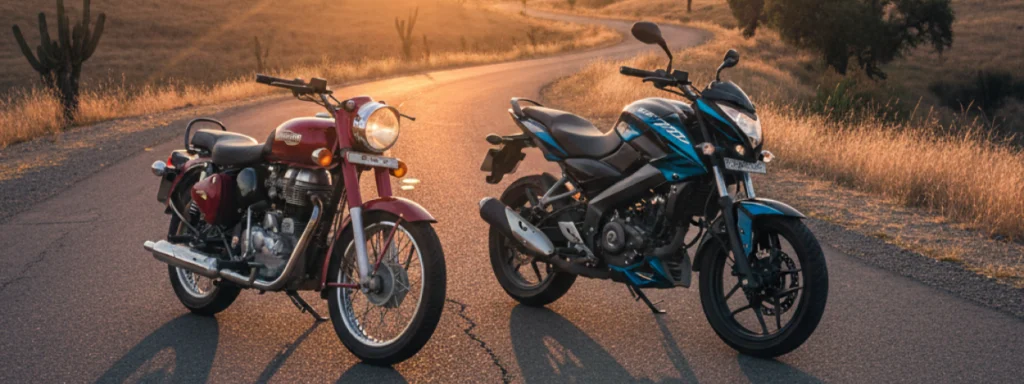
Royal Enfield and Bajaj are familiar names in the budget bike segment in India. One built a reputation on the fame of its rides while the other rides high in its price-versus-efficiency model. The two present the perfect scenarios where which bike you will choose is completely based on the preferences you have about what you want in a bike.
What really matters are pricing, mileage, effectiveness, operating costs, comfort, and features. Some riders are more concerned about the bike appeals and some care about how much fuel is saved. This discussion highlights the areas in which both lines fall short, thereby helping the readers with different options that are not biased towards either of the two.
Royal Enfield vs Bajaj: Quick Comparison
Here is the short version before we get into specifics.
- Starting price, Royal Enfield sits higher, roughly Rs 1.38 lakh onward for the Hunter 350, while Bajaj’s Pulsar 150 starts around Rs 1.11 lakh
- Engine performance, Royal Enfield leans toward torque and cruising feel, Bajaj leans toward peppier, quicker acceleration
- Mileage, Bajaj commuter models generally return better numbers, often in the 45 to 50 kmpl range against Royal Enfield’s 35 to 40 kmpl
- Maintenance cost, Bajaj tends to be cheaper to maintain long term
- Service availability, Bajaj has a wider dealer network, especially in smaller towns
- Ride comfort, Royal Enfield wins for longer stints in the saddle
- Features, both have narrowed the gap with digital clusters and connectivity, model dependent
- Build quality, Royal Enfield feels heftier and more substantial, Bajaj is lighter and more nimble
- Best suited for, Royal Enfield for road presence and touring, Bajaj for daily commuting and running costs
- Overall value, depends entirely on what you actually use the bike for, there is no universal winner here
Royal Enfield: What Makes It a Good Choice?
Benefits
The road presence of Royal Enfield is unparalleled in this segment, and people will remember their ride whenever they see a Bullet or a Hunter zooming past them. Royal Enfield motorcycles do offer an enjoyable riding experience with their torquey single-cylinder engines, which happen to be highly relaxing and soothing for some riders. Most of their motorcycles may be efficiently used for short rides as well as long-distance trips, and models like Classic or Meteor can withstand long hours on the road. With a solid build quality, these motorcycles are robust and last for a long time.
Things to Keep in Mind
Royal Enfield motorcycles are more expensive than the majority of Bajaj bikes in terms of purchase price and maintenance costs. Besides, the average mileage of numerous Royal Enfield models is lower than motorcycles with smaller Bajaj engines. The biggest disadvantage is that Royal Enfield bikes are heavier than Bajaj bikes, which can lead to serious problems when riding in crowded places like busy city areas.
Bajaj: What Makes It a Good Choice?
Benefits
Bajaj has a solid variety of budget bikes available to the customers looking for affordability in the motorcycle marketplace. Commuter models such as the Pulsar 150 provide reliable mileage at over 45 kmpl in a performance that meets all expectations for the price range given. Features such as Bluetooth connectivity and digital consoles are available even in budget bikes. If you are looking for a practical option for daily commuting, you wouldn’t find it better than Bajaj.
Things to Keep in Mind
It should be noted that there is a big difference between the comfort level and performance features when comparing different models. While some Bajaj motorcycles clearly aim at practicality, it may affect the overall appeal of the motorcycle.
Royal Enfield vs Bajaj: Detailed Comparison
1. Price
The starting price for entry-level Royal Enfields, particularly the Hunter 350, falls in the range of ₹1.38 lakh to ₹1.50 lakh ex-showroom. Bajaj’s entry-level Pulsar 150 is priced lower, starting at approximately ₹1.11 lakh. The price difference between the two brands is much bigger on their higher-end models. The price difference with Royal Enfield motorcycle is attributed to various factors, including the brand name, superior manufacturing, and features. Additionally, long-term ownership expenses need to be taken into consideration before making a decision based solely on the purchase price.
2. Mileage and Fuel Efficiency
Bajaj bikes are more fuel-efficient; for instance, Pulsar 150 delivers a mileage of around 45-50 kmpl. The fuel economy for Royal Enfield’s 350cc engine is usually 35-40 kmpl, mainly due to a more powerful engine. Other factors like the riding style can affect the mileage for both brands of bikes.
3. Performance
The Royal Enfield’s engine produces approximately 20 bhp and 27 Nm of torque that has been tuned for lower and less aggressive speed. The Bajaj’s Pulsar 150 generates about 14 PS and 13.4 Nm thus exhibiting better performance in the city speed. The torque provided by the Royal Enfield proves beneficial for driving at high speed. Overtaking and cruising becomes easier as it moves very smoothly on the highway. The Bajaj with its low weight is more convenient when a rider wants to use gaps while entering traffic. The riding experience on the Royal Enfield is much calmer when a rider travels long distances.
4. Maintenance and Service Costs
Routine maintenance, oil changes, brake system, consumables, etc. usually cost more for the Royal Enfield due to the high price of the parts and service labor. The Bajaj has better availability of service centers across regions making it more accessible for the riders. Following recommended maintenance schedule for both bikes is very important otherwise the cost of ownership will increase.
5. Comfort and Ride Quality
With Royal Enfield designed for comfort in terms of both seating position and suspension setup, it’s no wonder that they are the leader in this touring segment. Bajaj bikes, on the other hand, being much lighter, are easier to handle in stop and go traffic, a great benefit if your daily travel is only in a city. Moreover, the weight matters here since the heavier Royal Enfield would provide good stability during a ride, but can be laborious to handle in a traffic jam. In both cases, the choice boils down to what you are doing with your bike most of the time.
6. Features and Technology
Both Royal Enfield and Bajaj added digital displays and connected features in their models, closing what used to be a significant gap between the two companies. For example, Royal Enfield has included the very helpful Tripper navigation in Hunter 350 and similar versions. Bajaj also focuses on Bluetooth enabled models in its low-cost segments. On both sides, the lighting and security features are not in the same quality category, so one has to check specifications in every particular case.
7. Design and Build Quality
Because Royal Enfield stressed classic styling, that heritage look is among the reasons people buy the model in the first place. Bajaj’s Pulsar line bets on sportier looks that attract a different type of customer. Royal Enfield’s fit and finish invariably seems to be a bit nicer given the pricing. In the end, it all comes down to personal preference, so any opinion on which one is better is purely subjective.
Royal Enfield vs Bajaj: Which One Should You Choose?
Choose Royal Enfield If:
- You prioritize road presence and classic styling
- You want stronger low end performance and a relaxed riding feel
- You plan on taking longer rides or touring regularly
- You prefer a heavier, more substantial motorcycle underneath you
Choose Bajaj If:
- Mileage and affordability sit at the top of your priority list
- You need a practical bike for daily commuting above all else
- Lower running costs matter more than premium styling
- You prefer something lighter and easier to handle in traffic
Conclusion
Though Royal Enfield and Bajaj are made for entirely different types of riders, one prioritizing character and comfort while the other emphasizes practicality and operating cost. Ultimately, the right choice will depend on your budget, riding habits, expected highway mileage, and whether performance is more important than fuel economy to you. Instead of only considering the brand of the motorcycle, look at the specific motorcycle model you’re considering since it is the differences between motorcycle models of each brand which can be more important than the differences between the brands themselves.